miércoles, 26 de enero de 2011

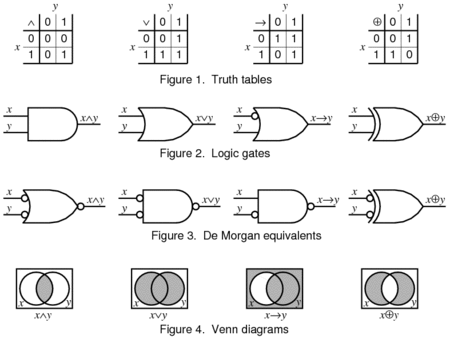
Various representations of Boolean operations


http://en.wikipedia.org/wiki/Boolean_algebra_(logic)

How many of the Irish cows are brown and fat?

Boole proposed that logical propositions should be expressed as algebraic equations. The algebraic manipulation of the symbols in the equations provides a fail-safe method of logical deduction, i.e. logic is reduced to algebra. Boole replaced the operation of multiplication by the word 'and' and addition by the word 'or'. The symbols in the equations can stand for collections of objects (sets) or statements in logic. For example, if x is the set of all brown cows and y is the set of all fat cows, then x+y is the set of all cows that are brown or fat, and xy is the set of all cows that are brown and fat.

Let z = the set of all Irish cows. Then z(x+y) = zx+zy; in other words 'the set of Irish cows that are either brown or fat is the same as the collection of cows that are Irish and brown or Irish and fat'.

lunes, 3 de mayo de 2010

La falacia

Ejemplos cotidianos:

El oro brilla.
Esta daga brilla.
Por lo tanto, esta daga es de oro.


Este es un ejemplo de falacia de afirmación de consecuente. Esta falacia tiene la forma:

P es Q
M es Q
Por lo tanto, M es P


Por definición, cuando un razonamiento es correcto y sus premisas son verdaderas, entonces su conclusión es verdadera. En este caso, tenemos que las premisas son verdaderas y la conclusión no necesariamente verdadera, ya que la daga puede ser de oro (siendo verdadera) o de otro material brillante como por ejemplo el hierro (siendo falsa). Por tanto, el argumento es incorrecto. La manera de saberlo es empleando contraejemplos que lleven al límite estas estructuras falaces.

Fuente:
http://es.wikipedia.org/wiki/Falacia

lunes, 1 de febrero de 2010

Lucila González Pazos

LUCILA GONZÁLEZ PAZOS

Nació en Pontevea (A Coruña) y reside en Madrid.

Es la Decana de la Facultad de Psicología de la Universidad Complutense de Madrid. Es Doctora en Filosofía, Licenciada en Filosofía y Letras y Diplomada en Psicología Pedagógica. Obtuvo el Premio Extraordinario en Bachillerato por la Universidad de Compostela y el Premio Extraordinario de Doctorado PCV la Universidad Complutense. Es titular del Departamento de Lógica y Filosofía de la Ciencia en la universidad Complutense. Como investigadora. está participando en programas de Lógicas Libres y Difusas, en el ámbito de la Inteligencia Artificial.

Fuente:
http://ordenvieira.com/p/q/Quien23.html

Publicaciones (según dialnet.unirioja.es):
http://dialnet.unirioja.es/servlet/extaut?codigo=1371026 ¡consultables en .pdf!